It’s now easy to see the deforestation risk of counties in 37 states thanks to the American Hardwood Assured Legal and Deforestation-free platform, created by the American Hardwood Export Council.
Detecting “very rare” forest to agriculture conversion
Designed for U.S.-based hardwood exporters to verify the legality and sustainability of their products, the free-to-use platform tracks hardwood shipments back to their county of origin, assuring downstream users that the harvesting methods comply with the European Deforestation Regulation. At the core of the platform is artificial intelligence trained to detect conversion from forest to agricultural land using satellite imagery from the United States Forest Service and cropland data from the U.S. Department of Agriculture.
“The definition that we’re using is based on the EUDR’s definition of deforestation. It means a conversion to agriculture,” AHEC International Program Manager Tripp Pryor says. “By training this tool to look for that, we then analyze the entire hardwood forest in the United States, and have identified where that change is happening.”
And that change, according to Pryor, is “very, very rare.”

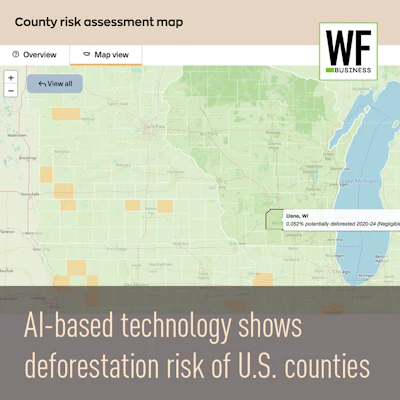
The county risk assessment map (pictured) on hardwood.us is free for the public to explore county-level deforestation risks. Counties in orange have an unspecified risk for deforestation at or above the set threshold of 0.5%. When risk at this level is flagged, the team at AHEC evaluates the data to ensure it wasn’t a misclassification by the AI. All other counties have negligible risk for their forest being converted to farmland. “For most of the hardwood producing states and counties, the risk of deforestation is extremely low,” Pryor says.
Why it matters
The AHA system shows the risk of deforestation at the county level, which alleviates the burden of certification from the individual forest owners. Historically, a certification from the Forest Stewardship Council was the only way exporters could prove their product was legally sourced and deforestation-free. However, acquiring the certification costs time and money, and for non-industrial forest owners—who represent the majority in the U.S.—it’s often not worth it. If exporters aren’t “able to put FSC labels [on their products] because of the 10 million landowners who have no interest in paying anybody when they only harvest once every 60 years, we know we’re losing market share,” AHEC Executive Director Mike Snow says.
Not to mention, the paper documents can be easily forged. “We’re losing market share based on a paper-based system that’s become less and less relevant, and it’s becoming easier and easier to take advantage of and falsify,” Snow says. “This can be done scientifically. Not based on who has what stamp along the way,” he adds.
In other words, the currently free and inalterable AHA system can take the place of time-consuming, paper-based certifications.
“The U.S. hardwood industry gets 75% of its wood from non-industrial forest owners,” AHEC Environmental Policy Director Rupert Oliver says. “The specific challenges involved in establishing traceability and demonstrating sustainability—AHA is a big part of the answer to that,” he adds.
Understanding deforestation risks in the States
While the shipment-tracking AHA Legal and Deforestation-free platform is only for producers and exporters of American hardwood products, anyone can use the tools on hardwood.us. “It’s engaging the much wider industry,” European Director for AHEC David Venables says. “In the long term, it clearly has a role for all of us in hardwood production. It shows companies within the states the legality of their state,” he adds.
The next phase of the AHA plan is to build out a proof of provenance system, in which any piece of American hardwood will be traceable back to its county of origin via “plant-chemistry-based testing procedures to identify harvest location of finished forest products,” hardwood.us says. Due diligence Proof of Provenance procedures are expected to be integrated into the larger AHA system by December 31.