Tom Wimberly, owner at TNT Machine Service in Marseilles, Ill., answers:
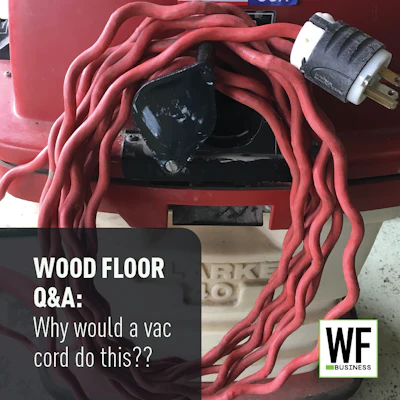
Wood Floor Business recently posted this photo on social media and asked people what they think caused it, and many pros said it was from wrapping the cord the wrong way—like around your hand and elbow. To be clear, doing that is really bad, but it doesn’t destroy the cord in that manner. (What that does is turns the cord into a giant figure eight and gives it a terrible memory when you unroll it.)
The damage we see in this cord is from the actual wires inside the cord heating and contracting and twisting on each other. What would cause that heat? It could be many things.
Buying a cheap cord will do that, because it’s poorly manufactured and poorly insulated.
Running a machine with a cord looped on itself will generate heat and do this. If you have a 50-foot cord on your vacuum but you only need 8 feet of it and leave 42 feet looped up together, that is horrible to do, because it will create heat. Experts say it can even catch fire, although I haven’t seen that myself.
Another thing that could create this is stretching the cord. If it’s stuck on a door casing and you yank on it, you will stretch the wires inside and the insulation, and now the cord’s compromised.
Running a motor too hot—like if the brushes on your vacuum or edger are worn—can make this happen, too. Or if you’ve been running the motor continuously for a long time without a break, that will create heat, so be sure to give the vac a rest or, if it’s a multi-motor vac, periodically change between motors.
I had the same cord on my big machine for 25 years, and when it finally started breaking down from wear and age, the first 10 feet of the cord kinked like the cord in this photo. When you grabbed the cord, you could actually feel that the kinked area was warmer than the rest of the cord. Usually this will start at the heavy end of the electrical draw, so one end of the cord or the other, not in the middle, although it will eventually work its way through the entire cord if you don’t replace it.
As soon as you see this, replace the cord. Replacing a cord is a relatively easy fix that almost anyone should be able to do, especially if you buy a good-quality cord. I always recommend buying one gauge higher cord than you remove, so if it was a 16-3 cord, replace it with 14-3.