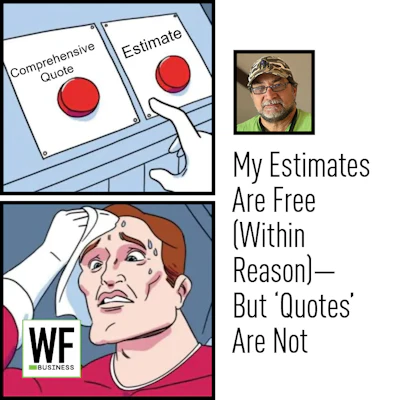
I have finally reached a conclusion about the difference between a quote and an estimate. It took a while, mostly because I (for the longest time) considered these two one and the same.
They are not—at least, not for me. Some of us have differing opinions about this, but I have settled the matter for myself, and this is how I think about it.
Most of us offer "free estimates," and these attract our future clients like bees to honey.
Yes, my estimates remain free, but within reason. With gas being more expensive, and with the time it takes to actually drive a few miles to measure and personally meet the clients, I'm personally inclined to not give away the farm. “Free” has a set and firm boundary. I'm not going to drive 30 miles or more for a "free" estimate if I can do 80% or more over the phone through a phone call and/or text. I can give the client a reasonably close number with just a brief description and some texted pics, but I'm not going to sign my name to it.
For heightened service, I level up to a comprehensive “quote.” These take time and effort, and I do not really give these away for free. Many times I make no mention of a price for a quote, depending on the circumstances, but instead add the fee into the price.
To clarify, I do not EVER give the clients a line-by-line, item-by-item quote. A carefully articulated (if not strategic) description with the manufacturer’s name and collection and/or color … sure, but no number or quantity and/or price each. The one total price is the “price.”
For a free estimate, I can look at an application and give the prospective client an idea where their idea is going. I always explain that my estimate is considering the good and proper way for the contract to happen, complete with adherence to best practices, industry standards and state and local mandatory guidelines. This is key, because we all know that some of our comrades compromise on the work to make the quote/estimate low—because that is their best and sometimes only weapon they possess to close a sale.
I'll not invest hours and hours of time for a free estimate. Now, for a quote I will. That's different, because they are comprehensive.
Let me give you an example about a mistake I made in this regard:
A local municipality called me for a gym floor refinish. It was within a few miles of my office, so I drove to the site and met the staff member who was in charge. I measured up and saw what the floor needed and left.
With gym floors that support basketball competition, the required finish is different from residential and sometimes commercial types. Sports floors are not my main function, but I do know enough to respect this aspect of this segment, so, there I was calling the NBA to learn more about the requirements. I got a lot of information I never knew existed. Then I had to source compliant finish and gave the municipality a good-better-best quote. If I had used a basic residential finish, I put myself in the path of jeopardy if an athlete injured themselves because of the finish type (litigation is no fun).
In the end I did not get this job. Curiosity led me to drive on over (since they went “radio silent” and were local to me) and talk to the staff member I had met previously. I was told they took the data in my quote and let their janitors do the work to save money.
I was simultaneously humiliated and enraged at the same time. I vowed to learn something here, and this was the inspiration for this topic.
What I should have done for this municipality was give a good guess and just leave. Let the staff member write it down or just remember the number on his own—I wouldn't care. If they remained interested, I would say great, give me a $X.XX quote fee and I'll send it. For this example, I spent hours on the phone gathering all the data and costs for the quote. I could've refinished a 500-square-foot floor in that time, and all I got for it was an insincere "thanks."
So, lesson learned. I don't mind spending the time to create a comprehensive quote—and losing—if I were paid for my time. (In a way, I do care, but we cannot get everyone anyway.)
Here's one more distinction. During the work we sometimes realize we should have charged more for something we should have thought about but forgot, like the labor to repair something we promised the client we would repair. This is why a comprehensive quote takes time. On large or complicated quotes, I'll finish and look at it again the next morning and go over it with fresh eyes to check every line, every amount and every promise to make sure it is accurate. Once you send it, it's difficult to ask for more once you sign the contract. For simple free estimates, adding onto the original estimate is not big deal, because I made the client fully understand that the number in my estimate was close—but not final.
One closing important note: I don’t actually sell by price at all. Price is a component of the sale, but not the whole shebang. There is also my license, my curb appeal, my decades of experience in the craft, my five-star reviews, my polite manner, etc. Price is a small part of the mix. The all-important “command presence" when meeting the clients for the first time is paramount, and way, way more important than price could ever be. (Maybe I’ll chat on this later if the topic has legs with this chat. Leave a comment if you agree.)