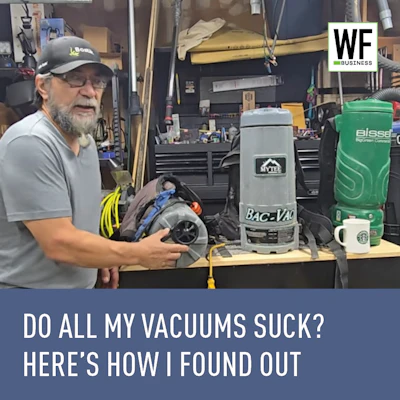
I’m answering the age-old question everyone reading asks themselves: Do all my vacuums suck? Or is it just the new one(s)?
One of my crew favored our new backpack vacuum over the older ones. They thought “they could just tell” it was particularly sucky in comparison with the others.
This got me thinking: How does one really know? And how can you tell which vacuum to buy when all the advertising is so compelling?
I’ve found the method to figure out … stick around.
Let’s bring science and tech into the chat. I did a deep dive on the internet and found an electronic device that is the exact tool to use to measure and document how much your vacuums suck. The tool is called an “anemometer.” (It’s kinda hard to pronounce; I initially called it “a Nemo meter” because it reminded me of Captain Nemo in the Nautilus from the Jules Verne novel “Twenty Thousand Leagues Under the Sea.” Or you can say it all together real fast any way you want.)
These devices come in an array of price points. I did the Amazon thing and spent a little over $30 for a device that sends the data to my phone so I can save it. That made all the difference to me. I balked at the expensive models for now because I wanted to learn more about this first.
As it turns out, the device itself doesn’t answer the question (my question is: “What is the CFM (cubic feet per minute) for each vacuum?”). You hold the device by your vacuum’s input, and it gives you a measurement for the air velocity in feet per minute.
You then have to get jiggy with math to interpret the data, but it’s simple high school math, so everyone can figure it out.
Feeling inspired, I tweeted Elon and he gave me some calcs from Space X that he favored and I’m like, “Bruh, I’m not launching rockets, I just want to know how much CFM each machine is creating."
So I went back to the internet, and after that high school math, the easy answer is complete:
CFM = velocity (in ft/minute) X ft2 of the opening of your vacuum hose
My backpack vacuums are 1 3/4 inch in diameter, and as far as I can tell, this is fairly standard across all makes. The formula we’ll all recall from high school:
Area of a circle = π x r2
I’ll show the math later if you use a 4-inch duct system in your shop or have a different setup—the math is easy, and you only figure it out once. The anemometer gives a result in “feet per minute.” You then just multiply that against the area in square feet of the inlet of your vacuum or hose. For the 1 ¾-inch hose on my backpacks, the number is 0.167. This number is more than likely the same for yours.
I chose three of my backpack vacs as test mules; two were bought in 2004 but mostly only one was used until the second was put in service only four yrs ago. This one sat in the rafters “just in case,” and that day finally came. These two were from a company called “Mytee” and are not made anymore. The third unit is two years old, and I bought it at Surfaces from the Bissell vendor.
A quick sidebar to acknowledge this: A vacuum is a very simple machine, no matter which one you speak about. It’s basically a can with a motor that spins a vane. Keeping the seals tight and the hoses intact is all the maintenance you do. For my part, I have ripped apart the motors to their individual parts and replaced bearings and brushes and put them all back together like new. All my backpacks are “single state,” which means just one vane or impeller. For other vacuums, I have replaced the motors and opted for larger vanes to increase CFM (kind of like the way you make things with Legos). For what it’s worth, I didn’t go to vacuum school, but I have been very successful keeping my old Mytee humming along quite nicely just doing basic maintenance.
Back to my anemometer project … readings were taken and documented. The data was transferred to a spreadsheet where all the numbers were in the same place so I can see with clarity the difference in the “suckiness” of each machine:

Curiously, the oldest Mytee ranked the best, the Bissell was in second place, and the “newest” Mytee ranked the worst.
If I did some careful scrutiny on the “newest” Mytee, eventually I could see where the leaks were and raise the output. Using the anemometer is the key so that I can “see” that any improvements done actually do factor into more CFM.
Other useful questions the anemometer could sort would be:
- Does a long hose decrease the suction?
- Is one brand of vacuum really better than another?
- Is a 220v machine better than a 110v machine?
- If a dual-stage motor were swapped into an old machine, would it be worth it?
- Can a splitter be used on the hoses to enable two sanders to work at the same time using only one vacuum?
- Congruently, how much CFM is needed if one vacuum is to handle two machines?
- Does a separator decrease CFM—or increase it?
- Is a larger hose needed if more CFM is desired?
You see where I’m going with this ?
Writing this got to be fun, because now I can tell the crew the oldest, clumpiest, ugliest backpack vacuum is the best vacuum! Haha! Also, I realized you don’t need to go “name brand,” because even the cheaper units I had bought did exceptionally well. I won’t name names, but I bet the orange brand of vacuum at a particular big box store is a great choice when you think about it. However, the silver vacuum from Germany being talked about was incredible when I saw it at Expo—no lies there for sure!
But seriously, the science behind this is awesome and a bit overwhelming. It may be easy for an engineer at Space X, but the calculations below are not daunting once you jump in and figure it out. I’ve done most of the math for you (I used Google).
Now that my backpack vacs are sorted, I’ll move onto the rest of my vacuums in order to establish a baseline for maintenance reasons.