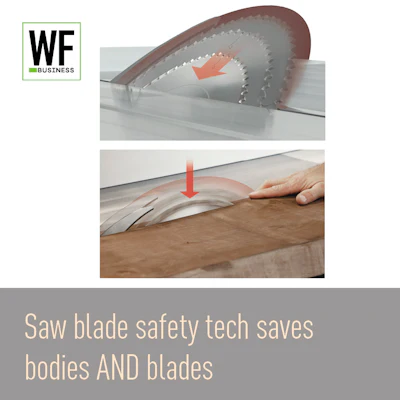
Table saw safety technology that detects human tissue before making contact, preventing damage to the body and the blade, is now available for smaller businesses thanks to the Felder K700 Series developed by the Austria-based Felder Group in partnership with the Vienna University of Technology. From 2010–2021, approximately 30,600 blade-contact injuries were treated by emergency departments in the U.S., according to the U.S. Consumer Product Safety Commission. That shakes out to 84 table saw injuries every day, resulting in production downtime and even permanent loss of a skilled worker and lifelong injuries. Felder’s Preventative Contact System technology is designed to prevent such accidents by monitoring the danger zone around the saw blade 1,000 times per second—up to 16 times more frequently than comparable systems, the company says. It also detects the “capacitive signature” of human tissue before contact with the blade, a feature that saves appendages and keeps the blade in working order: “The saw blade itself acts as a sensor and takes advantage of the fact that human tissue and wood have different electrical properties,” explains Robert Tratter, chief development engineer. “If a hand, arm or other body part approaches the danger zone, the entire saw unit—consisting of the saw blade, shaft and drive—is lowered beneath the machine table within milliseconds by an electromagnetic repulsion pulse.” PCS body- and blade-saving technology had been available for large industrial machines only, but is now integrated in the company’s K700 sliding table saws.—E.K.