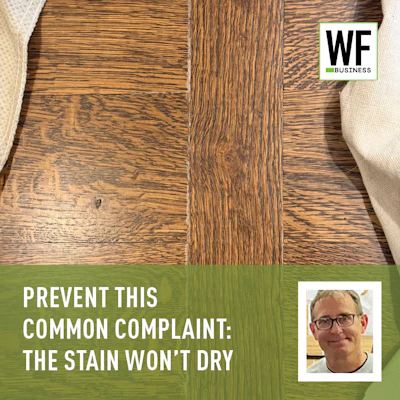
I’ve been a wood floor contractor as long as I can remember, but in recent years my job has been to train other contractors and help them deal with problems on their jobs. One of the top calls I get from pros is, “The stain just isn’t drying.” This is easily avoidable—let’s go over the top reasons why it happens and how to make sure it doesn’t happen on your jobs.
1) Wiping stain off
Back in the day, we all used to either rag-on, rag-off stain, or we would lambswool it on and wipe it off. This meant being down on the floor on our knees with our faces right over the solvents in the stains. Today, we no longer have to be down on the floor, because some smart contractor figured out we can apply stain with a buffer and wipe it off with a buffer! But, for whatever reason (sometimes thinking they will get better coverage), some people still like to apply and remove their stain by hand. The problem with that, particularly with stains that are pastel or dark, is that if you don’t wipe really aggressively, you risk leaving pigments on the floor. Back in the day, when we were all coating over stain with conversion varnish or oil-modified polyurethane, that didn’t matter as much, but a waterborne finish is not going to stick to pigments left on the surface of the wood floor. It might look good for a month, but eventually you will see peeling or other issues.
 White lines along board edges are one common result from not waiting long enough for stain to dry before coating.
2) Not testing to see if the stain is dry
It is a lot of time, effort and money to get to a point on a wood floor where you are ready to actually apply your first coat of sealer or finish over stain. Taking a few minutes to check that the stain is actually dry instead of just trusting the number of hours listed on the can of stain before you coat the floor can prevent having to start all over again. The best thing to do is put a vacuum on the floor over gaps, softwood or any other place where stain might have gone on heavy, and then see if you’re pulling up any stain with the vacuum. Another easy check is to wipe the floor with a rag of the opposite color of the stain (white rag for dark or brown colors, dark rag for whites/grays/pastels) to see if any color is still transferring to the rag.
3) Not optimizing the environment
Again, you’ve done all the hard work already to sand and stain—don’t risk it by leaving the floor at a temperature and relative humidity that might impede drying. Why not say, “Mrs. Homeowner, for the next 23 hours, can we leave the heat on and open these windows a crack to help the stain dry? That would help us stay on schedule.” If you make the homeowners aware, they’ll usually be cooperative. Even in summer, we’ve turned the heat on to help dry the floor and get the solvents out of the stain.
4) Not moisture testing
Your moisture meter isn’t just for installing—make sure you test the wood before you apply your stain. Wood that is too wet will cause the stain to dry slowly.
 The finish on this hickory floor peeled over a coat of natural stain that wasn’t dry, and now the actual wood under the peeled areas is stained dark.
5) Messing with the product
I looked at a job last year where the finish was peeling and turning white. After a lot of discussion, I found out that he mixed big box stain into quick-dry wood floor stain—but he expected it to still dry in two to four hours. For whatever reason, some pros try to manipulate or mix products, and that never ends well.
The thing that surprises me the most is how many people don’t follow the proper testing guidelines, even when they are on big jobs. It costs so much money to redo a floor—why not test it, or why not wait to coat it until tomorrow? Taking a few minutes to be proactive can save you thousands of dollars and prevent misery for you and your customers.
💡 Now take a quick quiz on what you've read: