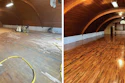
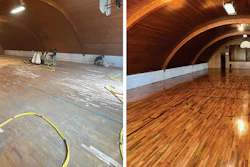
The call comes in—a local school, a community center, a church gym—and the job sounds familiar enough. Sand and finish a wood floor. You’ve done it hundreds of times. Wood floors are wood floors, right?
Not exactly. The differences between residential and gym sand-and-finish jobs are greater than you might think. That doesn’t mean residential contractors should automatically turn the work away, but walking in underprepared can be a costly mistake. Here are things to consider before you commit.
Gyms are their own challenge
Ensure your equipment and skills are up to the task. Walk-behind drum sanders are the wrong tools for gymnasiums. Most gym floors require ride-on, double-drum sanding machines designed for large, open spaces. The scale of a gymnasium demands consistent, uniform sanding across thousands of square feet of uninterrupted surface. Any variation in cut depth, drum pressure or travel speed can telegraph across the floor as visible waves or chatter that will stand out in a high-visibility athletic environment (and be extremely difficult to correct after the fact). If you don’t own ride-on equipment, you’ll need to rent or partner with someone who has it and factor that into your cost before you quote the job.
Know what you’re sanding. The wood itself adds another layer of complexity. Gymnasium floors are almost universally hard maple with existing game lines, logos, and embedded pigments that must be fully removed before the new surface is applied. That requires even passes that are deep enough to eliminate prior markings but controlled enough not to over-sand the wood face. Sanding too aggressively removes material you can’t put back. Sanding too lightly leaves ghost lines that will show through the new finish. There’s less margin for error than you might be used to.
Understand the performance standards. A residential sand-and-finish job succeeds when the floor looks great and holds up to daily life. In a gymnasium, appearance is the minimum threshold. These floors are engineered systems designed to meet specific performance standards for ball bounce, slip resistance and athlete safety. That means uneven sanding or inconsistent finish thickness isn’t just a cosmetic problem. It can directly affect gameplay, increase injury risk and expose the facility owner to liability.
Learn about the finish systems. Gymnasium floors require performance-grade products designed for heavy athletic use, not residential finishes. If you’re not familiar with gymnasium finish systems and the standards they’re expected to meet, that’s a knowledge gap to close with training before taking on a gym floor.
Recognize that line painting and graphics are critical parts of the job. Once sanding is complete, the next step involves game line layout and painting, which often includes custom graphics or logos.
Game lines must be measured, snapped, taped and painted to meet regulatory dimensions for basketball, volleyball, pickleball and whatever other sports the facility uses. Tolerances are tight, and errors are highly visible and permanent until the next sand-and-refinish cycle. The sequence is precise: sealer coats go down, lines are laid out and painted, logos are installed, and then additional finish coats encapsulate and protect everything. Logos and custom graphics require consistent color, clean edge definition and proper adhesion. If you don’t have experience with game line layout or graphics installation, you’ll need a qualified subcontractor who’s familiar with doing them.
Prepare for a tight timeline. Residential and gymnasium work share a common challenge: temperature, humidity and cure times are critical in both settings. One difference is the pressure: Gymnasium projects typically operate under strict, non-negotiable timelines between school terms, before a season opener or during a scheduled facility closure. There is little margin for environmental surprises or extended cure windows, and the stakes are high for completing work on time. A poor result disrupts schedules, affects athletic performance and reflects on the institution. Likewise, a gymnasium job done well is a showcase.
The bottom line
Gymnasium sand and finish can be a legitimate growth path for residential contractors, but it’s a specialized discipline, not a straightforward scale-up. The equipment is different. The performance standards are different. The finishing sequence is more involved, the wood is less forgiving and the deadlines are firm. If you get that call, don’t automatically say no. But don’t say yes without doing your homework first. Know the scope, then assess your knowledge and equipment gaps and fill them with the right training before you’re on the floor.