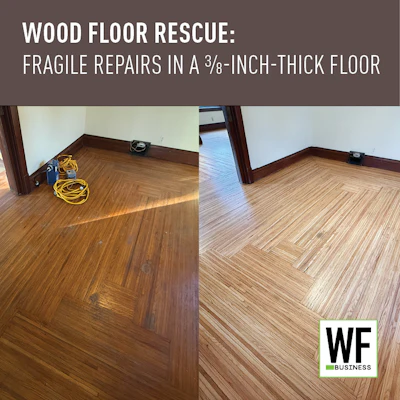
Daniel Acker, owner at Tiskilwa, Ill.-based, MD Hardwood Floors, says he enjoys the quirks of old houses, and in this case, that included figuring out how to restore a ¾-inch-wide, ⅜-inch-thick red oak floor original to an early-1900s home that had belonged to the homeowner’s grandmother. “This is the third ¾-inch strip floor I’ve worked on. They’re super cool, and I’m always in awe of them,” he says. “I’ve installed 1¼-inch strip, and that’s slow enough … I can’t imagine hand-nailing ¾-inch strip!” The groove side of the flooring is a common damage area, he explains, adding that the wear layer was only ⅛-inch when installed, and this floor appeared to have been sanded at least once. “The biggest challenge with floors like this is repairing broken areas,” he explains. “I can cut out and replace the broken pieces, but the surrounding flooring is near the end of its life, too, so the repairs end up getting sanded back to being near their breaking point in order to get things flat.” In this house the homeowner wanted to retain the original floors as much as possible, so Acker used epoxy to fill a few areas with broken groove-side edges. He used his Bona Power Drive to go from 40 to 120 before coating it with poly, matching an adjacent pine floor that had been refinished. “The homeowner was thrilled—a bit of her family history was restored. I was happy to have been a part of it,” Acker says.
SUPPLIERS: Abrasives: Norton Red Heat, Bona Net Ceramic screens | Buffer: Bona | Dust containment: American Sanders AVAC26 | Edger: American Sanders Super7 | Filler: West Systems epoxy | Finish: Niles Color Center Super 95 | Sander (palm): Festool Rotex | Sander (multi-disc): Bona Power Drive | Vacuum: American Sanders AVAC26