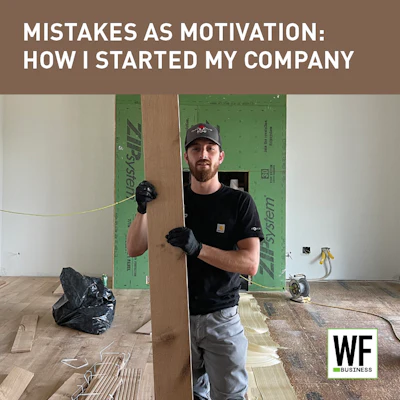
For me, becoming a hardwood flooring professional wasn’t something that happened overnight. It took years of long days, difficult jobs, mistakes, and a commitment to getting better every time I stepped onto a job. By the time I started my company, I had a clear idea of what I wanted it to be—and, based on where I had worked, what I didn’t want it to be.
I started in wood flooring in 2011 at 16 when I was on high school summer break; I helped my uncle where he worked. I will never forget my first day on site. We were fastening AdvanTech to a concrete slab with tap cons. He tasked me with screwing the tap cons while he pre-drilled the holes. I was struggling to get the tap cons set, and I was cussing and looking at the drill, like, “Why in the heck will these screws not set properly?” I took it to my uncle and told him it wouldn’t work. It turned out I had the impact in reverse. He gave me crap about that for the next year.
That summer was tough. I realized on day one how hard and physically demanding this trade is. But something about it made me come back for more the next summer. Once I graduated high school, I came back for my third summer, and that was the beginning of one heck of a journey.
Sanding by trial and error
At that point, I didn’t understand just how much went into producing a professional hardwood floor. The company I worked for specialized in strictly reclaimed lumber, and we laid thousands of feet of what was once barn siding and fence planks that had been re-milled into hardwood flooring.
With those reclaimed floors we had some leeway, as they were rough, with a lot of character—so much so it would help hide a lot of my sanding imperfections! We would sand with an 18-inch square buffer with 36, 50 and then 100—maybe a little more if we were staining. If bad overwood needed love, we would hit that with the palm sander. We didn’t have an edger. I did floors for two years before I knew how to use one; I knew of them, but we didn’t have one.
I’ll never forget the first “normal” floor I was tasked with refinishing. It was 1,200 square feet of a maple floor that was going to be stained. That’s when I realized I had absolutely no idea how to properly sand a hardwood floor. I really wasn’t even close. I think we rented an edger and used an EZ-8 sander on that job—we had no business doing what we were doing. The couple who lived in the house had been at a hotel while we were working, and we were meeting up with them at the house on the Friday after we stained it. As we walked up, the windows were open, and I’ll never forget how we could hear him telling his wife how horrible the floors were. Long story short, we had to redo that floor, and we did make it passable.
Mistakes become my teachers
Mistakes like that were frustrating at the time, but they became some of my most valuable teachers. Instead of allowing them to discourage me, I used them as motivation.
As you can probably tell, our company didn’t have any kind of training. My uncle had only done a handful of floors before he started there. I taught myself everything, and once social media blew up, I used that to connect with pros doing good work. I also knew a couple good floor guys in the area who I reached out to for pointers. I ended up talking with one in Louisville who told me about water-popping—I had never heard of it.
A plan begins to form
Hardwood flooring became more than just a job. It became a craft—one I had to perfect. By the time I was 23, I knew I wanted to start my own business, and when I did, it would be different from what I was experiencing. Besides having no training, we had crummy pay with lots of long hours and weekends and no benefits.
On Facebook, I was seeing all the nice equipment guys had. Where I worked it was like pulling teeth just to get a new hammer. If you needed something like a sander, you could count that out. We would pull up to jobs at $5 million houses and have to put cardboard underneath our vehicle to protect the driveway from the leaking fluids! I told myself when I started my business, we would have anything we needed.
At age 23 I had a young child and didn’t have the money to start a business, but in the back of my mind, I drew up a plan. I saved my money, and in 2023 I was able to buy the work van my guys are still driving to this day, and I bought a Hummel, a buffer and a Unico edger for $6,000 on Marketplace.
I turned in my notice and worked for four months at my old company while I did my own jobs after hours. I never wanted to run a one-man show—this business is too hard on the body—and fortunately, a coworker decided to come work for me.
One big job launches us
Once I had help, getting my name out there was my next concern, but my connections with builders and designers really helped. One builder hired me for a big 3,000-square-foot install, and I took the money from that and never looked back.
I knew I wanted to prioritize honesty in my company. Where I was before, they would tell people their 3,000-square-foot job was going to be done in 1.5 weeks when they knew darn well it would be at least two to three. Then the employees would be the ones getting an earful from the customer and rushing to finish. Today, when I start a big job, I tell them it will be a week longer than I think it will be. If we have to spend an extra day or two to get a job right, we’re going to, because there’s nothing worse as a business owner than having to redo a job—it’s a horrible feeling.
As an employee, I loved the work but hated showing up to work, because the company made life miserable. Today I have four guys, and I do my best to treat them differently. Don’t get me wrong: I’m hard on them about showing up on time and doing a good job, but I’m trying to pay well and focus on teaching them. I also plan to send them to training.
The goal: People know we care
I want every customer to look at their finished floor and know we cared about the details. If we encounter a problem, we’re going to find the right solution instead of taking shortcuts. My goal has never been simply to become another flooring company. I want people in central Kentucky to know they’re hiring people who care about doing the job correctly.
Every floor has a story, and so does every wood floor pro. Mine is a story about making so many mistakes, learning from them, and building something I’m proud of. And the best part is that the story isn’t finished yet. I tell my younger guys, “If you’re not messing something up, you’re not learning too much.” That’s all part of the beautiful process.