 Schönbrunn PalaceC.Stadler/Bwag
When one walks through the stunning rooms of Schönbrunn Palace in Vienna, Austria, it’s easy to get caught up in the gold-covered walls and Chinese-inspired decorations, but for wood floor pros, it’s the 17th-century palace’s intricate patterned wood floors that are jaw-dropping.
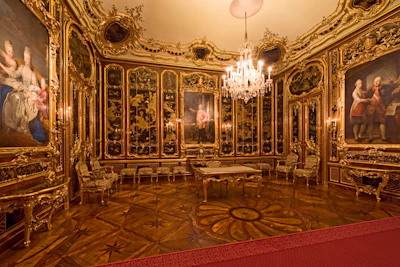
 The Vieux Laque Room at Schönbrunn Palace.Schloß Schönbrunn Kultur- und Betriebsges.m.b.H. Photographer: Alexander Eugen Koller
The Vieux Laque Room (above) was designed by Empress Maria Theresa as a memorial to her husband, who died in 1740. It features a parquet made primarily of sycamore maple veneer that has a natural shimmer. When sunlight hits it just right, a subtle checkerboard pattern appears, along with floral designs woven into the wood, reflecting the European Rococo style and Asian influence from the lacquer panels on the walls.
 The Round Chinese Cabinet Room at Schönbrunn Palace. Photo credit: Schloß Schönbrunn Kultur- und Betriebsges.m.b.H. Photographer: Alexander Eugen Koller
Rooms like the Round Chinese Cabinet (above) and the Salon of Empress Elizabeth (below) also showcase parquetry typical of the Rococo period. Their floors were made using exotic woods such as ebony, which was highly valued for its color in that time period. Their parquet patterns were inspired by the grand style of the Palace of Versailles and served as a way to showcase the empire’s wealth, palace officials say.
 The Salon of Empress Elizabeth at Schönbrunn Palace.
Photo credit: Schloß Schönbrunn Kultur- und Betriebsges.m.b.H. Photographer: SG Medienhaus.
Conservation is key, palace officials add, for flooring that represents centuries of history. To care for the floors, a trained cleaning team dry-wipes them daily, and the flooring’s condition of the flooring is assessed annually. Any potential damage is documented, and, if necessary, conservation and restoration measures are then carried out, preserving craftsmanship, culture and timeless beauty.