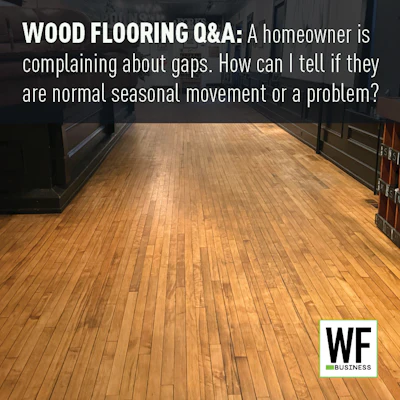
A homeowner is complaining about gaps. How can I tell if they are normal seasonal movement or a problem?
Todd Weyhmiller, director of product management, professional and new initiatives, at Englewood, Colo.-based Bona US, answers:
Start with a site assessment. Before doing anything, you need to understand what’s happening with moisture in and around the wood floor.
Record indoor relative humidity and temperature, then take moisture readings across multiple boards, including affected and unaffected areas. Use the appropriate meter settings for the species and compare your findings with installation records (if available) and the flooring manufacturer’s recommendations. One visit only provides a snapshot. Monitoring conditions over time can help determine whether the gaps are changing with the seasons.
Next, look at the gap patterns. Small, relatively uniform gaps throughout the floor often suggest seasonal shrinkage, particularly during heating season. Isolated or irregular gaps may indicate localized moisture differences, installation issues or other movement that warrants further investigation.
Don’t overlook what’s beneath the floor. Inspect basements and crawl spaces for leaks, dampness, exposed soil or inadequate moisture control. Where accessible, check the wood subfloor’s moisture content and compare conditions above and below.
If the evidence points to seasonal movement, address environmental conditions and allow the floor to stabilize before considering repairs. Gaps that persist under stable conditions may require a different approach.
If repairs or replacement are necessary, remember that long-term performance starts beneath the floor. Verify subfloor soundness, cleanliness, flatness and moisture conditions before proceeding. When appropriate, specify compatible primers, adhesives and moisture protection to help prevent future problems.
The bottom line: Understand the moisture conditions before deciding on the fix.