David Friedland, owner of Friedland Hardwood Flooring and Legacy Coatings in Orlando, Fla., answers:
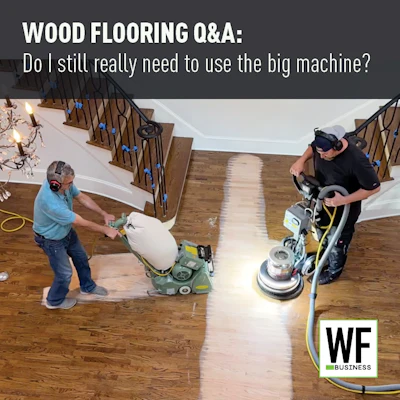
This is a question I ask myself often—especially when I walk into a job that’s under 1,500 square feet—because planetary machines have evolved quickly in recent years.
In many applications, belt and drum sanders are still faster—no debate there. But in some situations, it’s becoming harder to say that planetaries aren’t just as fast, if not more efficient.
Here’s why: Most belt and drum sanders are 8 inches wide, require forward and reverse passes and can only get 5–6 inches from the wall. After that, you’re relying heavily on the edger—not just to remove finish, but to flatten the floor. Then comes blending, scratch removal and fixing dish-out, chatter, waves, etc.
Some of today’s planetary machines are 17–18 inches wide, can get ⅜–1 inch from the wall and move 8–9 inches per pass when offset correctly. That means way less edging, scratch removal, etc. In a way, they allow you to refine the floor from the very first cut.
Today, when I’m going into a job, these are some factors I think about when I debate whether I need the big machine:
- How big is the floor, and how long do I want to stay on the same machine?
- Is the finish worn off? Do the homeowners have large dogs? Does the grain look like it has a deep wire-brushed effect? If it does, I certainly use the belt sander first.
- Is the floor water-damaged? Then I’ll use the belt sander first.
- What kind of finish is on the floor? If it is aluminum oxide or ceramic, I am going to use diamond segments on the planetary first.
For those of us who have been sanding wood floors for a long time, it can feel strange to think about whether or not we need our big machine for a particular job, but to sand most efficiently and with less wear and tear on our bodies, it’s important to consider using equipment that is easier to use and more forgiving, too.