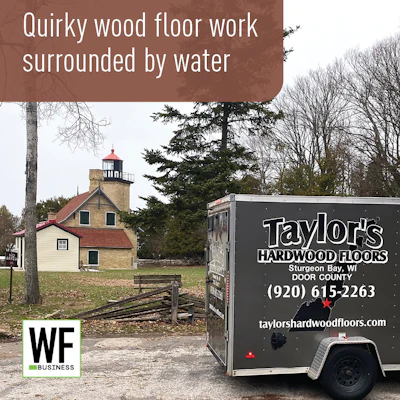
If you look at a map of Green Bay (the actual bay full of water that’s a part of Lake Michigan, not the place where the NFL’s Packers play), in the middle you’ll see a big island. And if you look at the end of the “thumb” of the state of Wisconsin (when you realize it’s the shape of a mitten), you’ll see another big island in Lake Michigan. They seem like improbable places for wood flooring jobs, but if you’re Taylor Elam at Taylor’s Hardwood Floors, based in Sturgeon Bay, Wis., those spots are within the realm of “normal” work—along with a few lighthouses, too.
When you live on a large peninsula, surrounded by water, that just becomes an interesting part of doing business, says Taylor Elam, who started his wood floor contracting business there 12 years ago. Along with the typical residential jobs that he can drive to like any other wood floor pro, his commute might involve a ferry, a barge or even a fishing boat.
For jobs on Chambers Island, in the middle of Green Bay, sometimes the general contractor has a barge, he explains. “You load all your stuff on this really slow-moving barge, and you’ve got to go when it’s calm and just slowly cruise out there,” he says. “There’s no power out there—everything is run off of solar or propane, so you have to run your stuff off a generator.” While he has the option to stay overnight, he opts to hitch a ride back and forth on an ocean-style fishing boat owned by the GC.
Jobs on Washington Island involve a long drive to the tip of the peninsula, then a ferry ride with his truck and trailer to the island. Because of the extensive commute, he gets a hotel or rents a house while he’s working there, “and then you’ve got to bring double of everything—you don’t want to be up there and not have something,” he says.
The ferry commute goes through an area of Lake Michigan known as “Death’s Door” due to the convergence of currents that have sunk many ships throughout history. “I was up there last winter, and when you go up in wintertime, that’s crazy, too, because sometimes you’re breaking the ice as you go through there,” he explains.
Lighthouses have their own challenges, even when you can drive relatively close to them, including getting equipment up tight spiral staircases and having the low light that comes with old-fashioned light fixtures, but Elam will never complain about the quirks of his work. “It is super cool and a unique place working on all types of odd projects,” he says. “It’s pretty awesome.”
Watch a video of Elam giving a tour of his work at the Eagle Bluff Light Station in Fish Creek, Wis.:
 Space for sanding was cramped next to the light in one of the Baileys Harbor Range Lights that guide vessels in Lake Michigan past treacherous reefs.
 The before-and-after shots of the wood floors in the Baileys Harbor Range Lights, which were built in 1869.
 Waiting for passage on a car ferry that takes vehicles to Washington Island through an area of Lake Michigan known as Death's Door due to the number of ships that have sunk there.
 Driving to a remote job on Washington Island after taking a ferry to the island in winter.
 The pine floors in the Eagle Bluff Light Station in Fish Creek, Wis., are original to when the lighthouse was built in 1868.