A mentor once told me a hard reality about wood flooring: “Buyers consider flooring a close cousin of a 2-by-4.” My addition to that? Only if you let them.
There are two basic wood floor facts
Two principles govern wood floors:
1) Buyers want natural products, including hardwood floors. That’s been true forever. LVPs and paper-thin veneers are budgetary compromises, not preferences.
2) Species traits are immutable. Wood isn’t “made”—it grows. You cannot manufacture better red oak, but you can choose and process better lumber. Creating wood flooring is closer to butchering beef than manufacturing. A tree yields both steak and hamburger. You can grind steak into hamburger, but you can never turn hamburger into steak. Lumber quality drives price.
What gives a wood floor value?
So, what makes the product less about price and more about value and your skill set? There are four attributes:
1) Thickness: This means the thickness of the hardwood wear layer, not just the overall piece of flooring. How much hardwood is the product made with? Is it ¾-inch with a 3-mm face or 4-mm face? A 3-mm face sucks value out of the product. The “sanding count” pitch was invented to justify thin veneers. When selling engineered, give clients the thickest sawn face their budget allows.
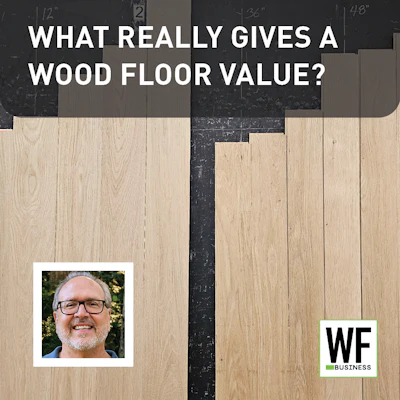
 These are both select-grade white oak—but the 5-inch product on the left exceeds the grade (for color and pin holes), while the 4-inch product on the right is closer to the minimum requirements for the grade.
2) Cleaner face: NOFMA grading is a baseline standard (below the rules is a failure), but here’s a hard rule: The better the lumber that was used, the overall cleaner the face and the more value the floor has. A Select & Better made from FAS lumber will cost more than a Select & Better from #1 lumber, but it will look cleaner (i.e., have less “allowed” character). The length and color consistency are just better.
3) Milling: This matters more to you as an installer, but it can show in the final product. It is the least visible attribute to the client, but it’s the most critical to you.
4) Lengths: Longer boards are worth more, and they look it. Length value is almost the opposite of milling: 10-foot boards are a headache to you, but for clients, long boards are better. I believe they see lengths as a combination of average length and median length. They see an average length calculation from a bunch of shorter boards and a rare full-length as ... a bunch of short boards. To calculate median length, sort a box or bundle by 1s, 2s, 3s, 4s, etc. Count the total number of boards going up from the shortest and count out half the total. That halfway board is what your client sees as the actual length value.
Once you have a clear idea of what clients perceive as the value of wood flooring, you will have an easier time explaining that the floor should have a value equal to the building’s value.