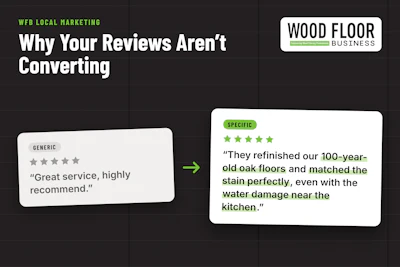
Why Your Reviews Aren't Converting
You've got fifty reviews and a 4.7-star average. Congratulations, that's not nothing. But if calls still aren't matching what your review count suggests they should, the problem isn't quantity. It's what the reviews actually say.
Here's what most wood flooring businesses get wrong about reviews: they chase the star rating and forget that the words inside the review do the real selling. A homeowner comparing three installers isn't just scanning for five stars; they're reading to see if someone like them, with a project like theirs, had a good experience. Generic reviews don't answer that question. Specific ones do.
The difference between a generic review and one that sells.
"Great service, highly recommend" tells a prospective customer nothing about whether you can handle their specific situation. Compare that to: "They refinished our 100-year-old oak floors and matched the stain perfectly, even with the water damage near the kitchen." That second review does more selling than any ad you could run, because it answers a real objection someone is likely holding: Can this company handle a floor like mine?
How to actually get reviews like that.
The trick isn't asking harder; it's asking smarter. Instead of a generic "please leave us a review" text after a job, prompt for specifics. Something as simple as, "If you have a minute, we'd love it if you mentioned what type of flooring we installed and how the process went," gets you review content that actually helps the next customer picture their own job. Ask for it right after the walkthrough, when the finished floor is still the most exciting thing in the room.
Negative reviews aren't the emergency you think they are. Your response is.
Every flooring company eventually gets a review about a delayed timeline, a color mismatch, or a subfloor issue that came up mid-job. What separates companies that recover from that review and companies that don't isn't the review itself; it's the response. A calm, specific, non-defensive reply that acknowledges the issue and plainly states what you did to fix it reassures the next reader far more than a wall of five-star reviews ever could. Prospective customers read your worst review and your response to it more carefully than your best one.
Recency matters more than volume.
A profile with 200 reviews from three years ago reads as stale next to a competitor with 40 reviews that include several from the last month. Google and customers both weight recent activity more heavily. If your last review is from last winter, that's a bigger problem than your total count.
The move here isn't complicated. Build the specific ask into your close-out process, respond to every review within a few days, and treat recent review flow as something to track monthly, not something that happens to you. Reviews are the closest thing to a walkthrough of a completed job that a prospective customer will ever see before they call. Make sure they show the work.
Reviews aren't a vanity metric; they're the most persuasive sales copy you'll never have to write yourself. Treat gathering and responding to them as part of the job, not an afterthought, and the words your customers leave behind will keep bringing in the next one.
Mark Goren is the owner of 10|20 Marketing, a Montreal-based agency specializing in local marketing and a proud partner of the WFB Local Marketing Service.