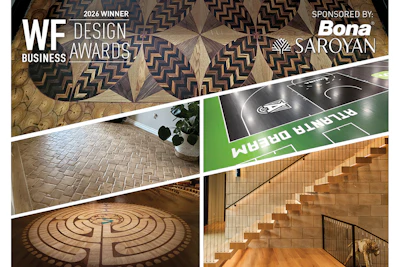
What a variety of stunning craftsmanship in this year's WFB Design Awards winners. A labor of love envisioned for two years in a pro's own home before he ever cut one board. A phenomenal portable basketball court with an important message. A winding floor steeped with spiritual meaning in a Canadian cathedral. A stunning reclaimed floor that appears 500 years old—crafted by a 27-year-old. And "Eternal Waterfall" stairs that appear to have continuous grain no matter the angle.
The winners for Best Residential, Best Commercial, Best Stairs, Best Gym and Next Gen (for companies owned by someone 35 or younger) were selected by an independent panel of wood flooring experts. Readers' Choice was chosen via an online survey. One winner will receive a $500 gift card.
This year, for the first time, each sponsor also chose a "Sponsor's Choice" winner.
To everyone who submitted to the 2026 Design Awards: Thank you. We want to see your future projects, as well. You can enter the 2027 Design Awards here. To see this year's winners, scroll down.
Readers' Choice & Best Residential
Courtesy of Floor Master Co.
Floor Master Co. | Crystal Lake, Ill.
Wood flooring life has transformed in a relatively short amount of time for Matthew Szyszka of Floor Master Co. “I remember times when I started in 2019 when there was no work; I had to borrow money to pay my guy. We were taking every single job … but we survived,” he says. “I set my standards high in the beginning, and it was tough.”
Today, after awards and accolades for his precise and creative work, the tables have turned. “Luckily l’m in the position where I don’t take every single project. Now I select the work I want to do,” he says.
This winning wood floor was a repeat customer and probably the pickiest one he’s had—himself. The space is his home office. Previously he had installed a plank floor there, making sure he didn’t use any glue, because he knew at some point he would demo the floor and create something unique.
This floor began randomly when he was still in bed. “One Sunday morning I opened my eyes and took my phone and started drawing circles. My wife was like, ‘You are crazy,’” he says. “I just drew some circles, and I left it. Some time later, I came back to that drawing, modifying and adding elements. It took a little over two years to complete that final design.”
Courtesy of Floor Master Co.
Courtesy of Floor Master Co.
Then he blocked out all of last October to work only on his office floor; the work continued on weekends and evenings into December, for a total of about seven weeks.
One of the trickiest aspects was deciding where to start—something he contemplated for a year before deciding the wenge and zebrawood chevron leaves should be the first elements. Each one has 98 pieces, and there are 36 of them. The wenge and zebrawood are ¼ inch thick glued onto ½-inch plywood. Once they were glued, he made a template and routed them out.
Courtesy of Floor Master Co.
Next he began on the stars, which are walnut and white oak, with the white oak grain carefully selected from plainsawn and quartersawn pieces to add a 3D effect.
“I wasn’t super careful on precision [on the stars], because I knew I would have a ⅛ inch strip around them, so I had some play,” he explains. “All the stars were in place and the glue was dry, and then with my router template from center I routered a ⅛ groove for the purpleheart.”
Courtesy of Floor Master Co.
Sourcing the end grain material for the border proved to be difficult, but then his friend Patrick Russell in Florida told him he had seen heart pine beams on Facebook Marketplace—and Szyszka happened to have a friend driving from Florida to Chicago.
Because of the resin in the heart pine, he had to use a ¼-inch blade on his band saw to shape the pieces one by one, scribing them to each other as he worked around the border. He didn’t install them tight to each other, as he wanted black filler between the pieces.
Courtesy of Floor Master Co.
When they were all installed, though, the sanding process was simple. “I had all my elements planed to uniform thickness, so sanding-wise it was super easy except for the border—especially with the black filler, it just killed the paper,” he says.
The satisfaction of having the floor done was worth all the years of planning and the labor to create it, he says. “It was amazing; I was so happy that it was done and completed,” he says. “I love that room; I love being there. I feel so pleased—it’s amazing.”—K.M.W.
Courtesy of Floor Master Co.
SUPPLIERS (advertisers appear in bold): Abrasives: Bona, Norton | Adhesive, Moisture barrier: Wakol | Edger: American Sanders Super 7 | Filler: Woodwise| Finish: Rubio Monocoat | Sander (multi-head): Bona Power Drive | Vents: TopStep Vents
Watch a video of this floor's process:
Best Gym
Courtesy of Praters Flooring
Praters Flooring | Chattanooga, Tenn.
The WNBA’s Atlanta Dream knew what they were doing when they partnered with Praters Flooring to design this first-of-its-kind, one-time-use “statement court” at State Farm Arena for the team’s 2025 home opener against the Indiana Fever. After all, Praters also designed and installed the team’s home court in Gateway Center Arena at College Park.
The two 2025 season courts are similar in that both feature bold gray stains and painted spray-fade aspects. In the case of this specially designed court that was temporarily installed at the home of the NBA’s Atlanta Hawks, though, the message was just as intense as the color scheme. The center court statement—“Pay Some Respect to Women’s Sports”—sums up the entire conversation around the WNBA in recent years, according to Praters Marketing Manager Anna Prater.
Courtesy of Praters Flooring
This court was designed in collaboration with the Dream, the financial platform Cash App and the apparel brand Playa Society to showcase a shared commitment to empowering female athletes. In addition to being featured at center court, the phrase “Pay Some Respect to Women’s Sports” was included on players’ practice jerseys and available on streetwear for fans.
The court’s spray-faded green border (to reflect Cash App’s branding) contrasts sharply with the dark playing area, which is accented with Cash App and Dream logos at either end. Zach Daniel, production manager for portable floors at Praters, says the company shared multiple painted and stained wood samples to help the team find the perfect tones. “The Dream very much had their own vision of what they wanted,” he says. “It’s difficult to pick a palette until you can see the colors on the actual wood surface itself. There were little or no changes on our side; it was more of figuring out what they wanted and then executing that.”
Courtesy of Praters Flooring
Once the Dream settled on the color scheme, the Praters team used Bona DriFast stain to create a darker, richer look than the typical combination of sealer and paint now used on many courts.
The dark stain/painted spray-fade border trend is evolving, as are special one-time-use floors, adds Cortney Griggs, a sales specialist for Praters' portable floors division. “This has been normal in the NBA for a while now—like an anniversary court or a statement court—but we’re finding that this is something the WNBA wants, as well. That’s what the Dream did, make a statement to bring more attention to women’s sports.”
Praters has installed colorful courts at the collegiate and even high school levels in recent years, and Daniel doesn’t envision that slowing down anytime soon. “More exposure to these types of floors will drive other teams to want to create a similar look and generate the reactions that teams like the Dream are getting from these floors,” he says. “A court like this is almost like a piece of art that you can play on.”
“The more people see this kind of court, the bigger and better they want theirs to be,” Prater adds. “Projects are getting wilder and crazier all the time. What’s fun is that customers bring us their vision, and then the challenge is for us to make it happen.”—M.P.
When Everette Simmons started Furniture Grade Floors LLC in Silverthorne, Colo., in 2024, he didn’t intend to become a stairs master. But two years later, Simmons installs just as many wood stairs as wood floors. And now his company has won its second consecutive “Best Stairs” honor.
“In 2020, I got an opportunity to do my first set of box treads,” Simmons says, recalling his time working at Colorado Custom Wood Floors in Frisco, Colo. “And I realized on that project that those stairs really were the focal point of the house. Stairs create an impact when you walk into a home.”
Perhaps the biggest impact a set of Simmons stairs has made can be found in the entryway to this sprawling 6,000-square-foot home at the base of Steamboat Ski Resort in Steamboat Springs, Colo. Self-dubbed “The Eternal Waterfall,” Simmons’s vision was to create a stunning element featuring “a continuous grain match no matter what angle the stairs are looked at.” To that end, the front and rear risers are made of the same 20-foot boards that grain-match from the first step to the top step—“to look like the trees flow upward,” Simmons says. The tops, bottoms and sides are all one piece, wrapping around the tread. No end grain is shown on the 19 stairs, each with 36 miters.
Courtesy of Furniture Grade Floors LLC
Simmons wanted the stairs—which ascend to a great room—to look like they’re floating off the stone wall, when they actually are supported by tube steel built by Cold Fire Steel (one of Simmons’ welding friends) that extends from the stone.
“We custom-made the cable railing to look like it was invisible from most angles, so that the focus is on the wood stair details,” Simmons says, adding that the treads were wire-brushed and finished on-site with a ceruse-lime look, which he notes brings the outside mountain vibe into the home.
Courtesy of Furniture Grade Floors LLC
Sourcing the perfect wood for this project turned out to be a four-month endeavor, with Simmons ultimately finding what he was looking for at Birch Creek Millwork in Terreton, Idaho. He knew he wanted to use plainsawn wood grains and selected boards that emphasized grain diversity, with darker ones in the middle of each step and lighter boards on either side.
The project is one of several Simmons has done in this home, including floors, accent walls, ceilings and another set of stairs. Once the wood was acquired, it took the three-man crew two months to complete—about a month longer than Simmons anticipated—and he jokes that he didn’t charge the homeowner enough money. But he also was given carte blanche, which makes up for the underpricing.
“I told them, 'If you just trust me and let me use my creative vision, I’m going to give you something that you’ve never seen and that will create a jaw-drop factor when people walk into this house,'” Simmons says. “When we were done, I got a call from the homeowner after they moved in, and the woman was in tears. I was worried, until she said, ‘Man, this feels like the largest piece of art in our home.’ And they have some beautiful art. That was probably the highest compliment I’ve ever received.”—M.P.
Watch a video of this project:
SUPPLIERS (advertisers appear in bold): Abrasives: Norton, Bona | Adhesive, Buffer, Filler: Bona | Edger: American Sanders Super 7 | Finish: Berger-Seidle | Moisture barrier: Wakol| Moisture meter: Wagner| Nailer: Hitachi, Porter Cable | Router: Bosch | Sander (big machine): Hummel | Palm sander: Festool | Saws: Festool, Sawstop | Wood flooring: Birch Creek Millworks
Next Generation
Courtesy of MacDonough LLC
MacDonough LLC | Attica, Mich.
A repeat customer—and the owner of this ranch-style home in the rustic community of Metamora, Mich.—pointed to his 10-by-10-foot concrete slab of a foyer and asked Austin MacDonough, “What can you come up with?”
Not one to turn down a challenge, the owner of Attica, Mich.-based MacDonough LLC came up with what he calls a “wood Tetris” design featuring century-old hand-hewn beams that were cut into 1-inch end-grain slices and pieced together.
Courtesy of MacDonough LLC
“I honestly didn’t know how it was going to turn out,” says the 27-year-old winner of the Next Generation category for the second year in a row. “But it turned out incredible.”
MacDonough wanted to create a wood surface that looked like a 500-year-old cobblestone road and reflected the locale’s rich outdoor history, and that involved texturing and pillowing the pieces once they were in place. He procured several old barn beams and western wagons wood from Reclaimed Michigan, a Waterford, Mich.-based supplier of reclaimed wood and salvaged lumber—all kiln-dried and bug-tested—and then he and his install partner, Austin Miller, went to work.
“We sliced them, fit all the pieces together and glued them in with Bona glue,” says MacDonough, who’s been in the wood flooring business since he was 18 and launched his own company in 2023 at age 24. “I started from the center of the room and worked my way out, just Tetris-ing the rest, leaving 1/8-inch to 3/8-inch gaps. We needed some weird shapes and had to jigsaw some to fit. There are some triangles in there, too. Definitely all shapes and sizes.”
Once everything was dry, MacDonough and Miller used sanders to pillow the edges into each other, creating that weathered cobblestone look. Next, they track-sawed out the border, which is rough-sawn 5-inch white oak. Then they applied several coats of finish, and once everything had cured, they applied the grout.
That last step, MacDonough says, proved to be the most challenging. The grout—a mix of fine dust from sanding, cork dust and a poly finish with white stain that MacDonough calls “redneck grout”—dries faster than standard grout, with edges that required grinding and sanding.
Courtesy of MacDonough LLC
“I like the different color tones, I like the natural look, and I love the textures,” MacDonough says when asked his favorite aspects of this project. “All the floors we do are textured, and I’m constantly feeling them and touching them. I’m like, ‘This feels awesome!’”
MacDonough provided the homeowner a 2-by-2-foot mockup of what he had in mind, “and then they just let me go nuts,” he says. “They were in Florida when I did the project, and when they came back, they were pretty surprised.”
This project turned out so well, in fact, that he thinks a similar treatment would look terrific in commercial settings, such as restaurants with an antique aesthetic or wine rooms, or even a private wine cellar. MacDonough also wants a floor like this for himself.
“In my next house, I’m definitely going to put that in my foyer,” he says.—M.P.
SUPPLIERS (advertisers appear in bold): Adhesive, Finish: Bona | Moisture barrier: Wakol | Palm sander: Festool | Saws: Festool, DeWalt
Best Commercial
Courtesy of J.L. Vivash Custom Wood Flooring
J.L. Vivash Custom Wood Flooring | Paris, Ontario
When Jason Vivash was contacted to potentially create a 27-foot-wide labyrinth on a tight timeline for a cathedral a little more than an hour away, he and his three employees were already absorbed in the most complicated custom residential job of his career. So, of course, he said yes, and along the way he added details to make the cathedral job even more difficult.
“I couldn't say no,” Vivash says. “I want to be making stuff like this.” The work order involved dropping a labyrinth into the just-installed 8,000 square feet of prefinished engineered oak flooring that was part of a major cathedral renovation, but when he saw the design, in addition knowing he needed to make improvements to the grain orientation and the scaling, Vivash saw a missed opportunity.
Courtesy of J.L. Vivash Custom Wood Flooring
The labyrinth’s center called for a simple pattern, but he thought it was underwhelming. “The whole idea [of a labyrinth] is that when you reach the end, you’re supposed to be spiritually enlightened. I was like, ‘Let’s help with that idea and help them focus on something beautiful and creative in the center.’” When Vivash offered to create the center inlay at no cost, the church officials were thrilled and quickly generated many meaningful ideas.
Creating the entire labyrinth took all of Vivash’s equipment, tools and skill—working long hours seven days a week for the five weeks they had to do the job. “It has been a huge learning curve, but between my two lasers, the CNC bed and the Shaper Origin, it’s become second nature—part of the challenge,” he says, explaining that each one suited different parts of the job. Additionally, as he created the mountains for the center inlay, he found doing it by hand with his scroll saw was the best option.
Courtesy of J.L. Vivash Custom Wood Flooring
Of course, designing pieces to fit perfectly on the computer for a 27-foot diameter is one thing, and reality on the jobsite, with a subfloor that isn’t perfectly flat, is another. The pieces must be built so that adjustments can be made when things start to go slightly off during installation. “In my experience, that’s the beauty of knowing how to do it by hand, because when things get complicated and go off, you can resort to old-school tricks and fix it,” Vivash explains. “It’s all just numbers and tools and tolerances.”—K.M.W.
This floor was originally supposed to be 2-and-1/4 strip, but when Cesar Cardona saw a pile of 2-by-4s from the demolition process inside the home that had been in the client's family since the mid-1900s, he envisioned end grain made from the reclaimed wood. That vision morphed into a mosaic, and the repeat client ended up giving Cardona free rein. "We were calling him every time we had a new idea. At one point we called him five times in a day," Cardona says. "Finally he said, 'Don't call me anymore! Just do whatever you do—I trust you.'"
Because the job was not a rush, they were able to take their time installing, even having Cardona's wife, three children, two of their significant others and his crew all installing mosaic together on weekends. "We were all joking and laughing; it was a nice experience," Cardona says.
Courtesy of Cardona Flooring
They did such a good job installing the mosaic that it needed to be sanded with only the Power Drive, and then they chose to use Bona Chroma to darken the border and highlight the mosaic before coating it with Traffic, preserving a special reclaimed floor to last in a family home for many more decades.—K.M.W.
SUPPLIERS (advertisers appear in bold): Abrasive, Adhesive, Buffer, Filler, Moisture barrier: Bona | Edger: American Sanders | Finish: Bona Chroma, Traffic | Moisture meter: Tramex | Router, Palm sander, Saws: Festool
See a video of this floor here:
Sponsor's Choice: Saroyan
Courtesy of Woodwright
Woodwright | Dallas, Texas
There’s no straightforward process for installing a three-level handscraped hexadecagon (16-sided) medallion. Add the client’s request for maple inlays with a natural look apart from the rest of the floor, and you’ve got a bit of a puzzle. So when Woodwright was contracted to do the Old Parkland Theater floor under a tight deadline, the team had to get creative.
“We came up with a new technique. Instead of cutting all the pieces first and putting them together, we modularized the areas of flooring where the inlays were going to go,” Woodwright’s Vice President of Sales and Marketing Rick Farrell explains. “We then put that module on our CNC router and cut out where the inlay was going to go in one big piece.” Because the maple inlays were not handscraped or stained like the rest of the floor, they had a “more brilliant look of a medallion without having to do it in a traditional way,” Farrell says.
Courtesy of Woodwright
Working in a confined space alongside other trades added to the job's complexity. “Not only was it an extremely small, confined space with 50-foot ceilings, there were literally people on scaffolding working on the ceiling while we're trying to do the floor ... they had every trade in there all at the same time,” Farrell says. Against all odds, the floor was finished on time.
But, as with any handscraped, tung-oiled floor, the work doesn’t stop. The theater floor and Woodwright’s other Old Parkland campus floors have “given us the opportunity to develop a maintenance plan, so now we're constantly down there touching up and re-oiling floors,” Farrell adds.—E.K.
All Things Wood Floor, created by Wood Floor Business magazine, talks to interesting wood flooring pros to share knowledge, stories and tips on everything to do with wood flooring, from installation, sanding and finishing to business management.


 Courtesy of Floor Master Co.
 Courtesy of Floor Master Co.
 Courtesy of Floor Master Co.
 Courtesy of Floor Master Co.
 Courtesy of Floor Master Co.
 Courtesy of Floor Master Co.
 Courtesy of Floor Master Co.
 Courtesy of Praters Flooring
 Courtesy of Praters Flooring
 Courtesy of Praters Flooring
 Courtesy of Furniture Grade Floors LLC
 Courtesy of Furniture Grade Floors LLC
 Courtesy of Furniture Grade Floors LLC
 Courtesy of MacDonough LLC
 Courtesy of MacDonough LLC
 Courtesy of MacDonough LLC
 Courtesy of J.L. Vivash Custom Wood Flooring
 Courtesy of J.L. Vivash Custom Wood Flooring
 Courtesy of J.L. Vivash Custom Wood Flooring
 Courtesy of Cardona Flooring
 Courtesy of Cardona Flooring


 Courtesy of Woodwright
 Courtesy of Woodwright
 Courtesy of Woodwright